Class
Family
Genus



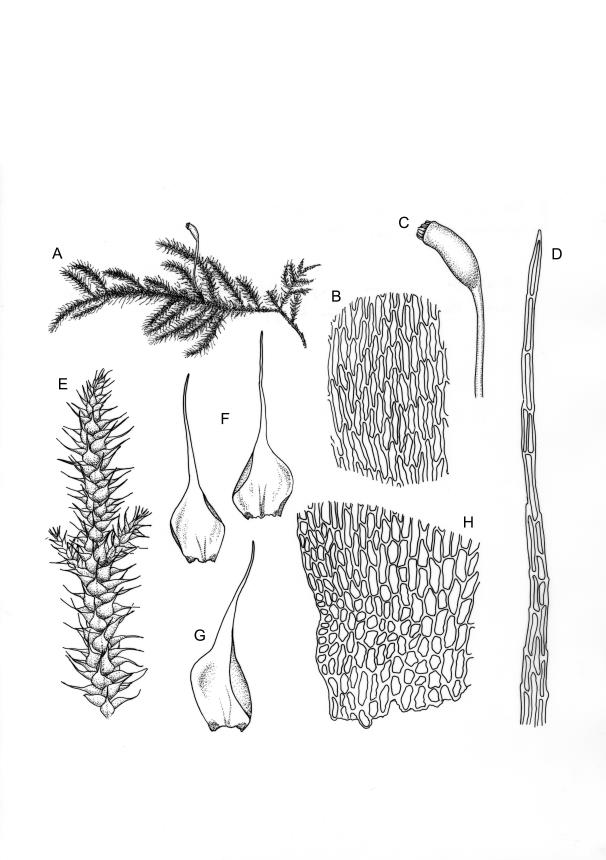
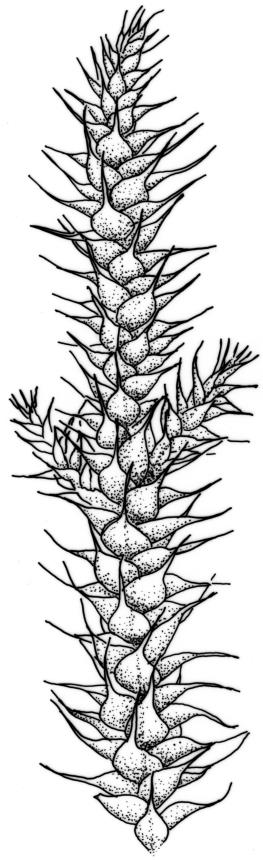
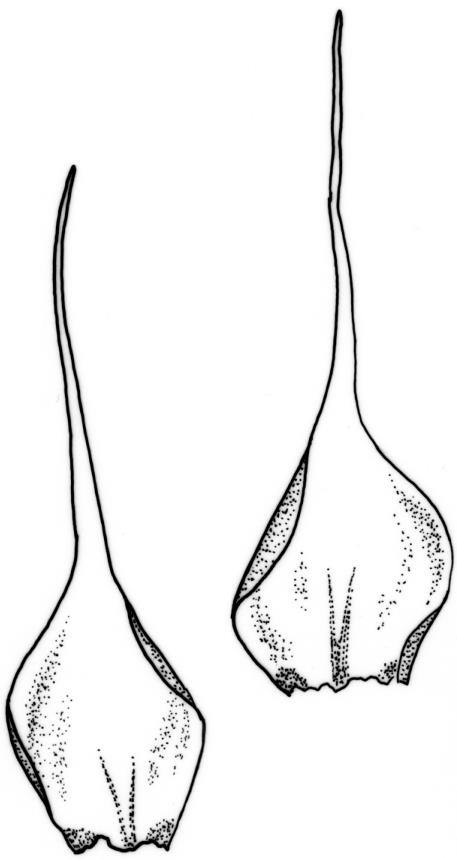
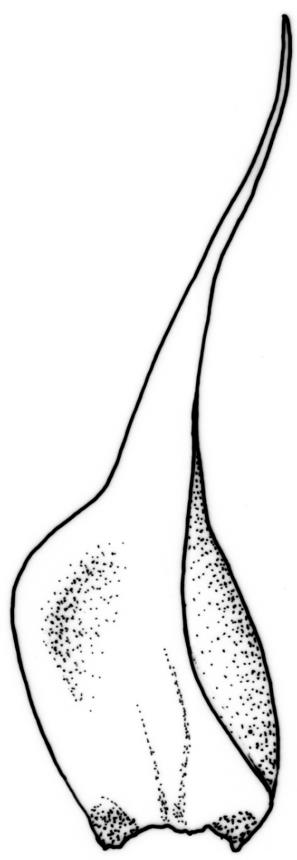
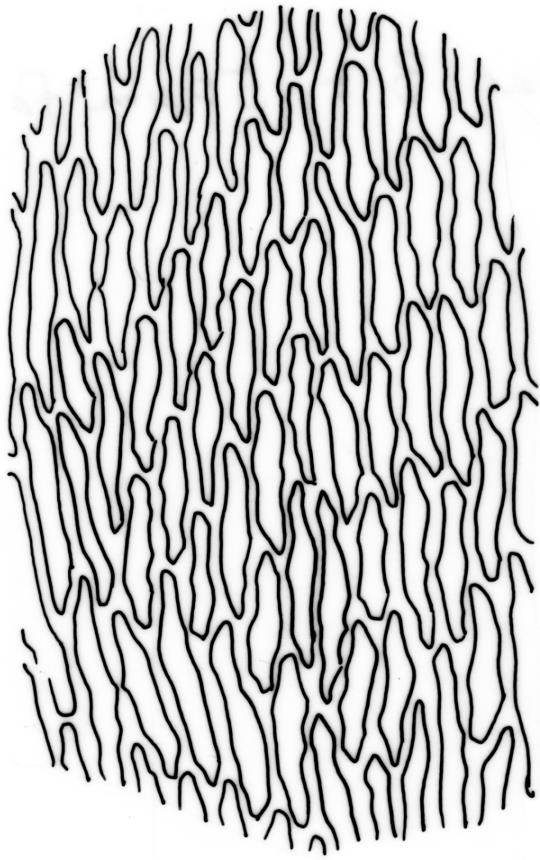
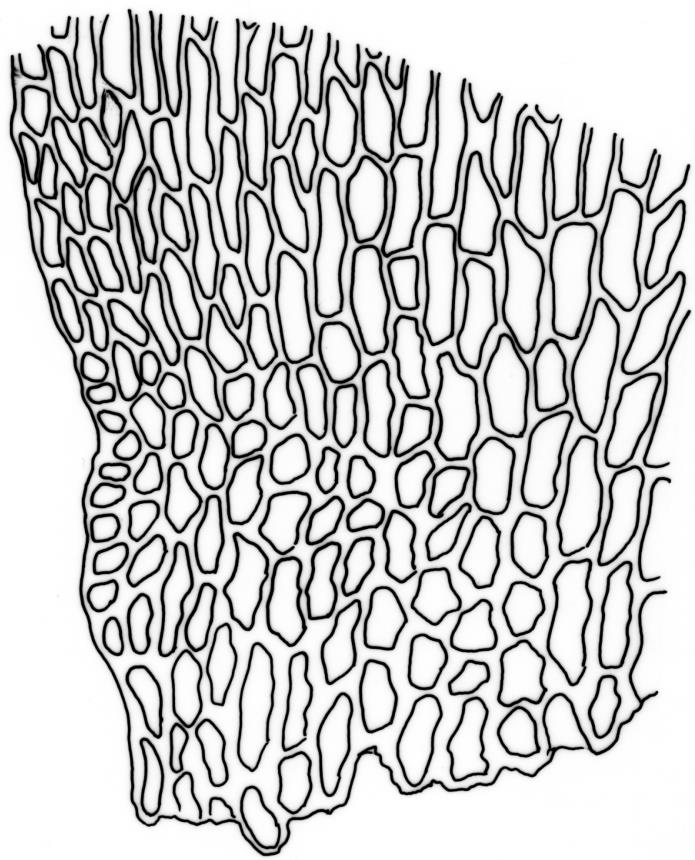
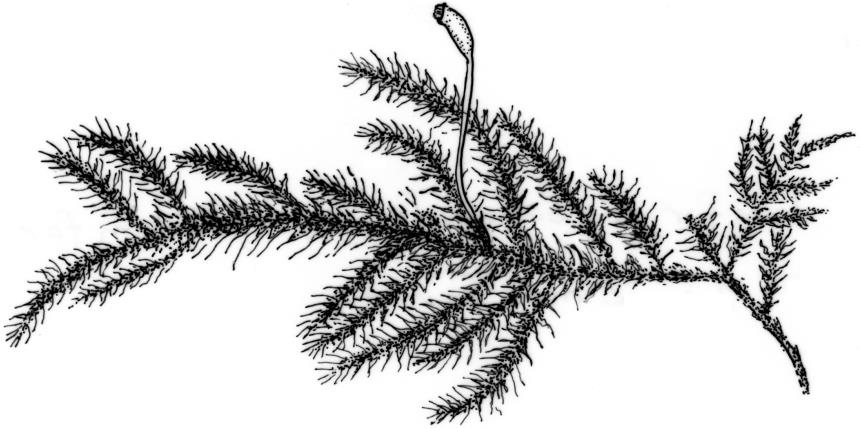
Plants usually robust, (20–) 30–40 (–100) mm long, dark olive-green, dull, forming loose wefts on bark, exposed roots and rocks. Stems ± erect to scrambling, variably stipitate; in cross-section oval, c. 700 × 500 µm, with an outer layer of c. 6–8 (–10) cells surrounding a core of parenchyma and an indistinct central strand. Branches straight, sometimes rooting at the tips. Pseudoparaphyllia c. 240 × 155 µm. Stem leaves imbricate, inflated-smooth when moist, ± unaltered when dry, widely ovate-oblong, concave, apex flexuose, aciculate, with the hair point 1.2 to 1.7 times the length of the lamina, wider than long, 0.85–1.0 × 1.2 mm, with alar cells irregularly walled, porose, to form a dark group 8–10 cells wide and extending 8–10 cells from the leaf base. Costa weak usually double and failing below mid leaf. Branch leaves smaller, with a smaller alar group, longer than wide, 0.7–0.8 × 0.4–0.6 mm, with hair points 0.8–1.1 mm. Mid laminal cells linear, ± sinuous, firm-walled, prorate, weakly porose, 40–50 (–60) × 5.0 µm; becoming longer above (–100 µm), those of the hair point (40–) 50–60 (–90) × 5 µm.
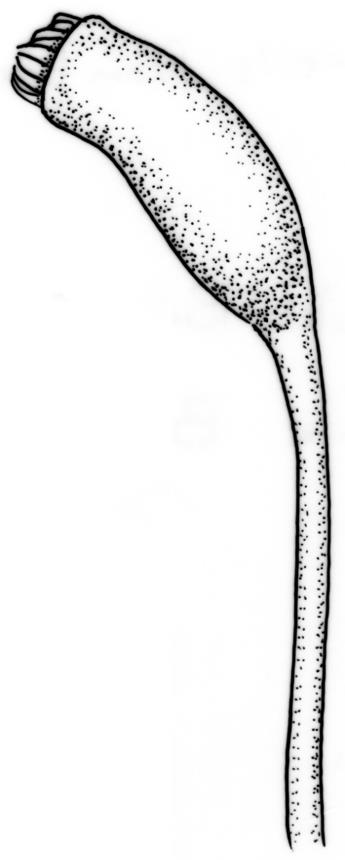
Setae to c. 10 (–15) mm, flexuose. Capsules 2.0 × 0.7 mm; exothecial cells ± irregularly arranged, c. 15–20 (–27) × 12–15 µm. Stomata present on the capsule base. Operculum blunt to apiculate, c. 0.5 mm. Exostome teeth c. 450–500 µm long; endostome with a basal membrane c. ½ –¾ of exostome. Calyptra c. 2 mm. Spores 15–17 µm.
Sainsbury 1955, pl. 61, fig. 2 (as Camptochaete aciphylla).
The leaf apices extended into a long arista as long as or longer than the leaf lamina are diagnostic for this species, and it is unlikely to be confused with the other species.
SI: Nelson (Owen Range, Cobb Valley, Lake Peel, Mt Mytton), Otago (Blue Mts, Mt Cargill), Southland (Chalky Inlet, The Catlins, Eyre Mts); A; C.
There are specimens of Fifea aciphylla in WELT from Westland LD (Nephrite Creek, Griffin Range, D. Glenny) and Southland LD (Mores Scenic Reserve, Riverton, P. Beveridge, P. Brownsey). (Not seen).
Endemic.
Relatively rare, sometimes locally common; on tree trunks and logs, rocks and crevices, humus and leaf litter in mostly shaded habitats, in forest and in open grassland and shrubland. Occurring mostly above 900 m; from near sea-level in Fiordland (Chalky Inlet) to 1480 m in Nelson (Mt Owen), and 1450 m (Lake Peel), and at lower elevations in Otago, 150 m in The Catlins, and 500 m on Mt Cargill.
The specimen in BM-Dixon was annotated by Dixon as ‘Type’, and specimens in WELT are annotated by Sainsbury as ‘co-type’.
The stipes are mostly weakly developed, only occasionally are plants strongly stipitate, and the fronds are typically regularly bi-pinnate and tidy. New shoots can be produced from the fronds and the branches may become attenuate, with rooting at the tips relatively rare (e.g. H.H. Allan, 1.2.46, Fisherman’s Bay, Chalky Inlet, Fiordland, Herb. Sainsbury, WELT M005680; P.N. Johnson 14/47, Auckland Island, WELT M10553).