Class
Family
Genus



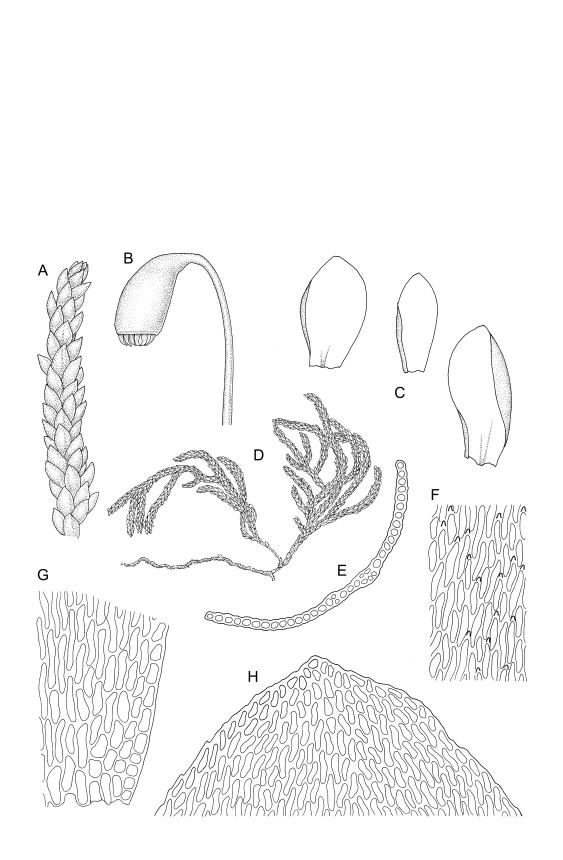
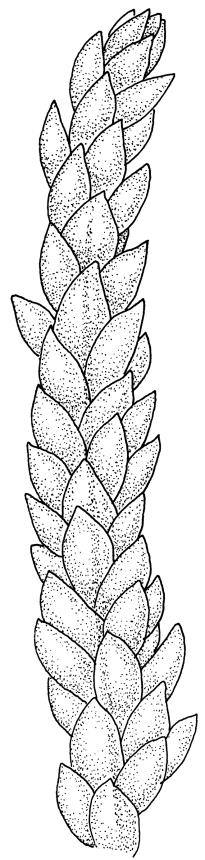
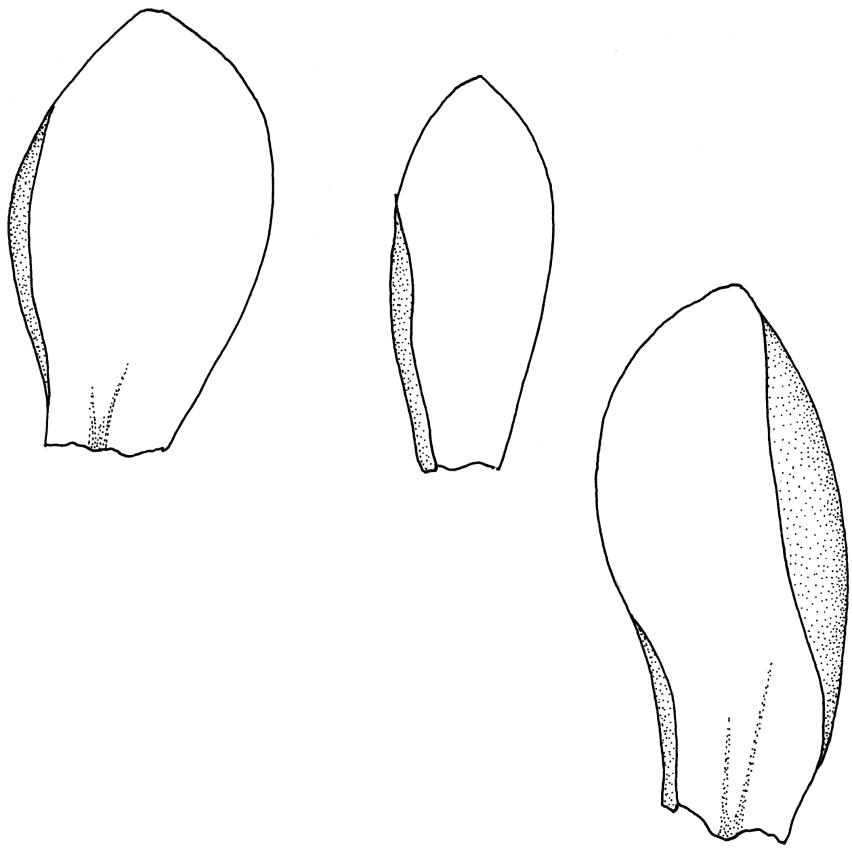
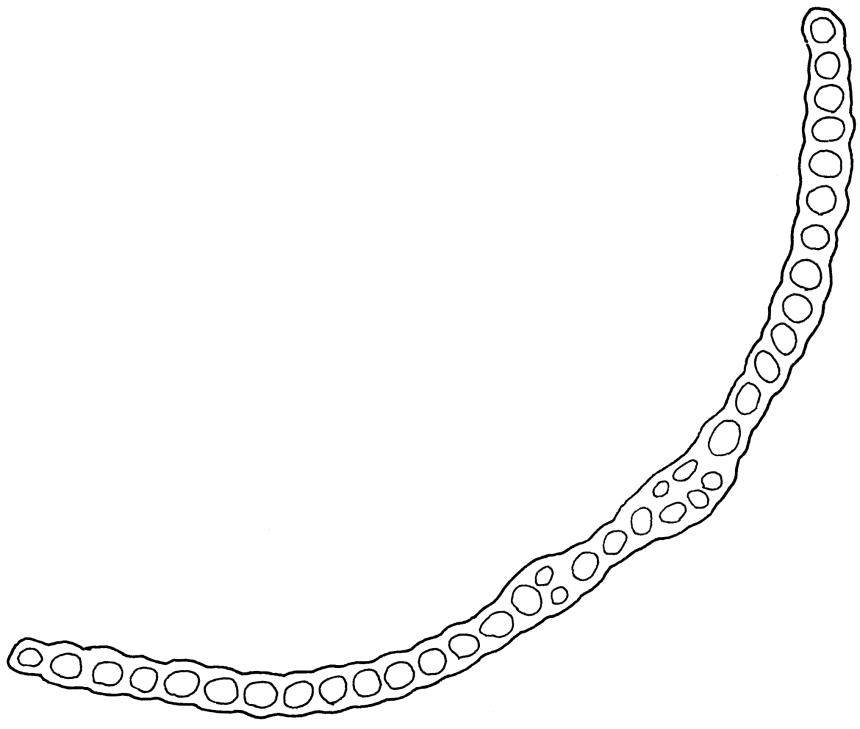
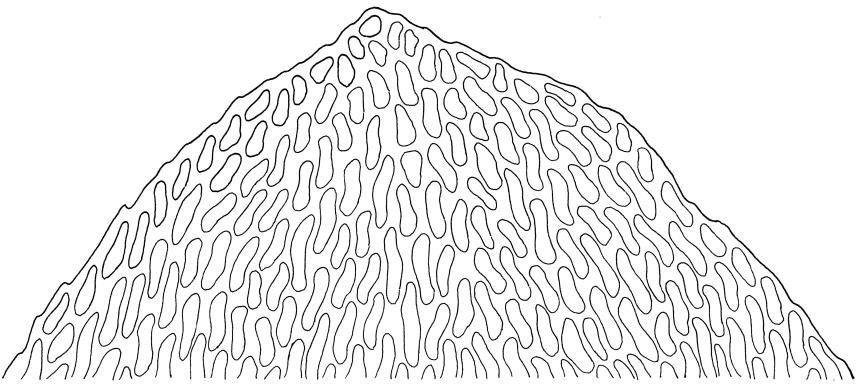
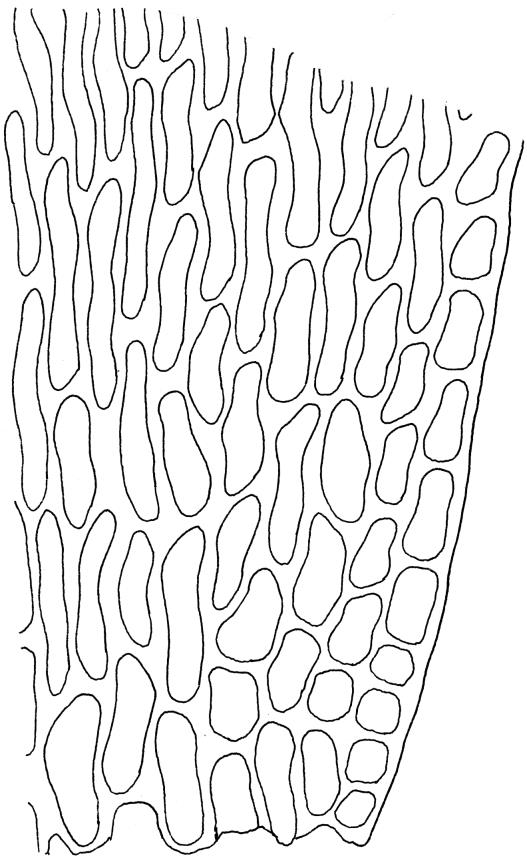
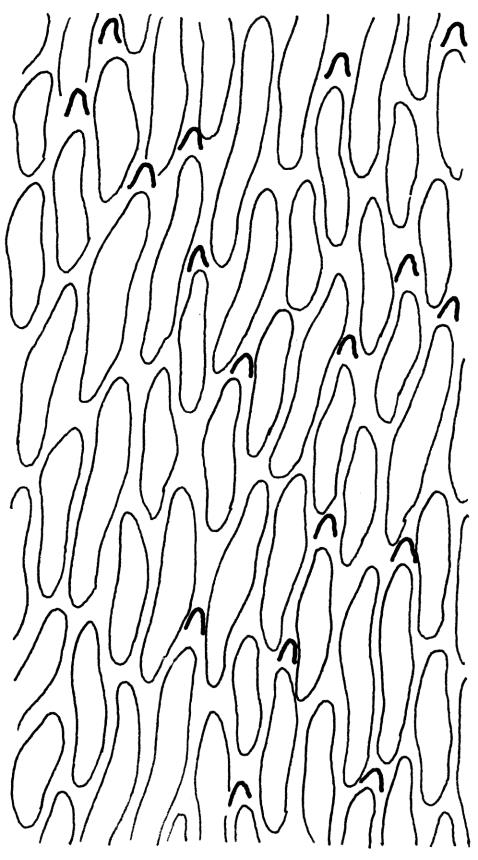
Plants slender, dull or slightly glossy, usually forming tightly appressed mats on rocks or bark. Stems usually creeping and forming ± irregular but mostly pinnate fronds; in cross-section c. 210 × 250 mm, with an outer layer of 4–5 cells surrounding an inner core of parenchyma, with no central strand. Branches 0.4–0.6 mm wide. Pseudoparaphyllia c. 110 µm long. Stem leaves usually homomallous, inflated-smooth and weakly concave when moist, little altered when dry, ovate to elliptic, obtuse to widely acute, 0.75–1.1 × 0.5–0.6 mm, at the margins mostly plane (sometimes weakly incurved above or weakly revolute below) and serrulate above, with alar cells ± quadrate, pigmented, and forming a group c. 6–8 cells wide and extending c. 10 (–13) cells from the leaf base. Branch leaves smaller than stem leaves, usually homomallous, blunt and lacking an apiculus, 0.45–0.8 mm, with a smaller alar group. Mid laminal cells prorate to prorate-papillose, (18–) 24–36 × 4–6 µm, those at apex rhombic or ± irregular, c. 9–12 µm long.
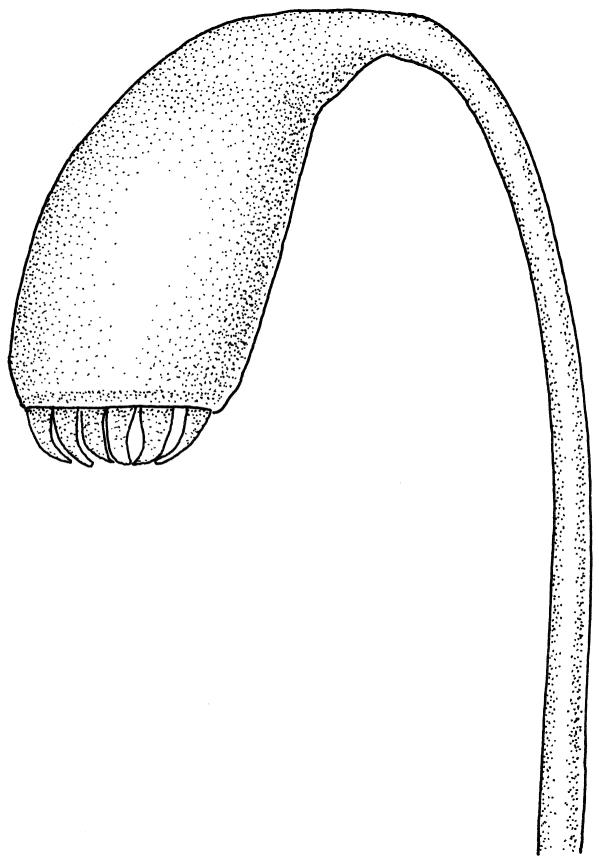
Dioicous. Setae c. 12–20 mm, weakly twisted to the left. Capsules c. 1.5–1.8 mm long; exothecial cells 25–45 × 12–17 µm. Operculum highly variable, apiculate or short-rostrate from a high conic base, asymmetric or symmetric, c. 0.35–0.5 mm. Calyptra c. 2 mm. Spores 12–15 µm.
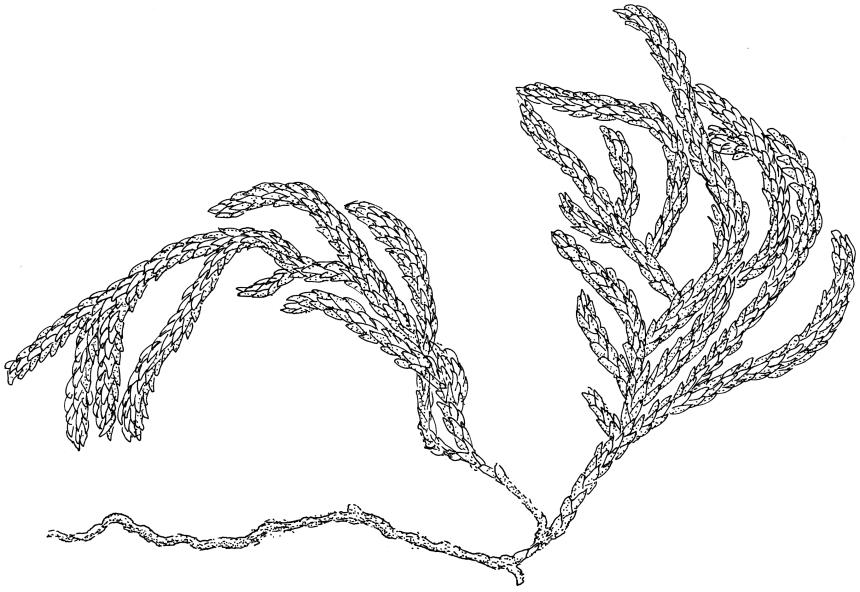
Sainsbury 1955, pl. 61, fig. 1 (as Camptochaete gracilis); Tangney & Fife 2003, fig. 1.
Fallaciella gracilis is a distinctive plant not readily confused with other species. The plants are small and form pale, tightly attached, olive green to brown mats with narrow stems and branches. Amongst the N.Z. Lembophyllaceae, it is the only species that produces tightly attached mats. This distinctive feature is, however, underlain by the same branching architecture that is shared by the other genera and is typical for the family (Tangney 1998). This feature is somewhat obscured by the plant size, but it is observable across a range of material.
The plants are soft, compared to the larger tough and wiry plants of Camptochaete. Fallaciella gracilis also differs from Camptochaete in having its leaves dull and little altered when dry, and only slightly concave when moist, with the upper margins plane. The leaf apex is usually widely acute and lacks an apiculus. In other N.Z. Lembophyllaceae the leaves are typically semi glossy and greener, only occasionally brown, more deeply concave, and with the upper margins typically incurved. Unusually for the family, F. gracilis often produces papillae on the distal cell prorae. The presence of leaf prorae is common in Camptochaete and in other Lembophyllaceae, where they are present as slight protrusions of the cell ends, but in Fallaciella gracilis they are marked, and are sometimes visible protruding from the backs of leaves.
Fallaciella gracilis is a smaller, more tightly attached and often duller plant than F. robusta, which tends to be larger, more loosely attached and with glossier leaves. Fallaciella gracilis is a finer plant with slender stems and branches, and leaves little altered when dry, typically ovate, slightly concave when moist, with the upper margins plane, and the apex is usually broadly acute. F. robusta has leaves more deeply concave with upper margins incurved and an apiculus which is often recurved. In addition, prorae of the mid-laminal cells of the branch leaves are frequently papillose in F. gracilis, whereas the prorae of F. robusta are smooth.
NI: N Auckland, including offshore islands (LB, GB), S Auckland, Gisborne, Taranaki (Taranaki Maunga), Wellington; SI: Nelson, Marlborough, Canterbury, Westland, Otago, Southland; St; Ch; A; C.
Austral. Tasmania*, mainland Australia* (Qld, N.S.W., A.C.T., Vic.), Chile*.
Relatively common in forested stream beds, where it is found mainly on rocks and exposed tree roots, occasionally on damp earth. It is also found on the same substrates in more open and upper elevation habitats, including subalpine scrub and more rarely on soil in subalpine grasslands. It occurs from sea level to c. 1430 m on the South I. (Temple Basin, Arthur’s Pass, Canterbury L.D.), and to nearly 1300 m on the North I. (Taranaki Maunga and the Tararua Range).
The type material of Isothecium gracile in BM (J. Buchanan (in herb. Gourlie), comprises a number of specimens (BM 000850985 to BM 000850993 inclusive. A lectotype has not been selected.