Class
Family



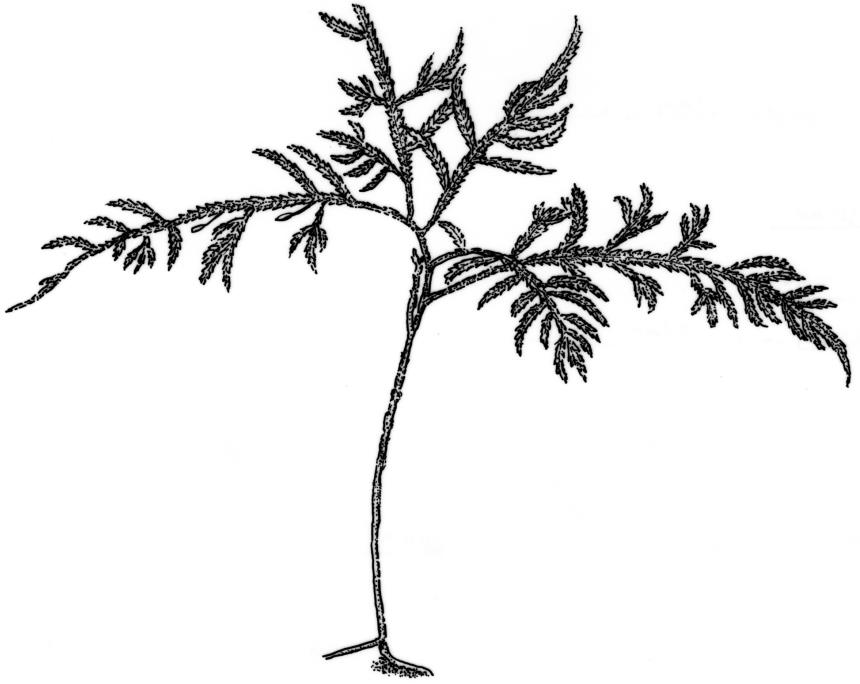
Plants robust, mostly rigid and wiry, pale yellow-green to light olive-green or brown-green, glossy to dull; forming loose wefts on trunks of trees, exposed roots and rocks, occasionally on the ground. Stems creeping to erect-ascending, stipitate; fronds 2(–3)-pinnate, ± regular, mostly complanate. Branches frequent, straight or curved when dry. Pseudoparaphyllia foliose, broadly triangular. Leaves erect-spreading, rarely falcate secund, sometimes catenulate, smooth when moist, loosely wrinkled, or not altered when dry, moderately to strongly concave, obovate, ovate to orbicular, obtuse or acute to acuminate, sometimes mucronate, sometimes cucullate; margins plane, incurved, entire or denticulate above. Costa short, double and faint, or absent, rarely single and extending to the upper lamina. Mid laminal cells linear, sigmoid, not or weakly porose, firm- to thick-walled, prorate; those above rhombic and thick-walled, those below irregularly rectangular, and thick-walled. Alar cells pigmented or not, forming a ± triangular group weakly differentiated from the adjacent basal margin.
Dioicous or pseudautoicous. Inner perichaetial leaves with apices reflexed from an oblong sheathing base, acute to acuminate. Outer perichaetial leaves much shorter and more obtuse. Setae mostly elongate, flexuose, smooth, red-brown to pale purple. Capsules nearly erect to horizontal, smooth, symmetric or curved, shortly oblong-cylindric (1.5–2:1), red-brown; exothecial cells oblong, sometimes quadrate, thick-walled. Stomata absent. Peristome diplolepideous; exostome teeth lanceolate, shouldered, bordered below, pale yellow-brown, outer face striate or striate-papillose below and finely to coarsely baculate above, bullate at the apex, with a zigzag median line; inner face with well-developed lamellae, smooth below, and baculate above; endostome yellow or hyaline, finely baculate to bullate; with the basal membrane c. ½ the height of the endostome and with segments keeled and perforate-cracked, finely baculate to bullate. Cilia 2–3, well developed, nodulose to appendiculate. Operculum blunt to short-rostrate from a high conic base, symmetric. Calyptra smooth. Spores spherical, pale yellow-brown, coarsely baculate.
A genus of 10 species distributed in Australasia. The generic concept utilised here excludes those species removed from Camptochaete by Crum (1991): Camptochaete (Fallaciella) gracilis and Camptochaete (Fifea) aciphylla. The four species recognised in N.Z. were included in section Camptochaete by Tangney (1997), characterised by erect imbricate stipe leaves and a blunt-apiculate operculum.
Plants of N.Z. Camptochaete are typically rigid, wiry, and subdendroid, producing branched fronds held on unbranched stems (stipes), and some of the species produce elongate trailing forms. They differ from the other N.Z. Lembophyllaceae in having well developed stipes and densely branched fronds that are consistently and regularly 2-pinnate. The other genera differ in being either smaller plants with weaker stipe development (Fallaciella), or by having loosely branched or indistinct fronds (Weymouthia, Lembophyllum). Fifea can have neat 2-pinnate fronds, but it differs in its long hair-like leaf apices.
Important features for identification of the N.Z. species are: leaf size, shape, orientation, degree of concavity, disposition wet and dry, and leaf apical form. In species that produce elongate (‘deflexa’) forms the branches and terminal main stems become elongate and attenuate. The leaves become smaller, more slender, and distally grade into the form of ‘embryonic’ leaves, lacking specific characters. Leaves with characters more typical of the species can usually be found in the basal parts of elongated growth. See below for discussion of Camptochaete deflexa.
| 1 | Frond axis and branch leaf apices falcate-secund | C. pulvinata |
| 1' | Frond axis and branch leaf apices not falcate-secund | 2 |
| 2 | Branch leaves narrowly ovate-lanceolate (l:w > 3.5), serrulate, weakly concave | C. angustata |
| 2' | Branch leaves broadly ovate to oblong (l:w < 2.5), ± entire, concave to strongly concave | 3 |
| 3 | Fronds ± regularly 2(–3)-pinnate, mostly compact; frond axes and branches mostly complanate; leaves usually not in neat spirals, concave, obtuse, subobtuse or acuminate | 4 |
| 3' | Fronds not pinnate, loosely and openly branched, frond axes and branches inflated and sub-julaceous; leaves neatly spiralled, very deeply concave, abruptly and distinctly mucronate | C. arbuscula var. tumida |
| 4 | Plants pale, light green to yellow-green; setae short, robust, 4–5 mm, with capsules held on the underside of fronds; leaves collapsed-wrinkled when dry, strongly concave and cochleariform, ± oblong, subobtuse to widely acute or mucronate; cells in leaf apex short, l:w usually < 2 | C. arbuscula var. arbuscula |
| 4' | Plants darker, green or olive-green to brown-green; setae elongate, slender, 8–10 mm, with capsules held above the fronds; leaves not markedly altered when dry (and then occasionally striate-wrinkled), moderately concave, ovate to broadly ovate, acute to acuminate; cells in leaf apex elongate, l:w > 3, usually 4–7 | C. deflexa |
| Category | Number |
|---|---|
| Indigenous (Endemic) | 1 |
| Indigenous (Non-endemic) | 3 |
| Total | 4 |