Class
Family



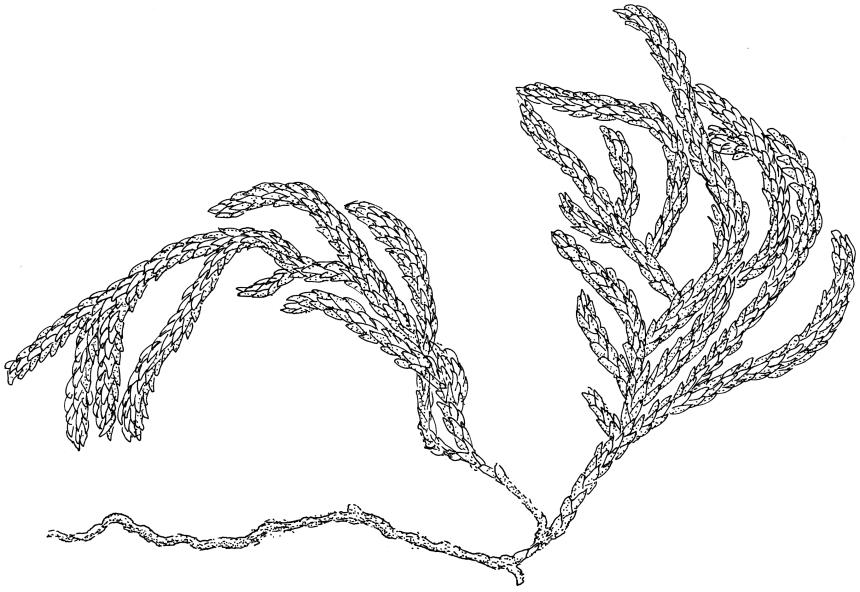
Plants slender to moderately robust, not rigid, pale, brown- to light green, dull or glossy, forming usually tightly appressed mats or compact wefts, on rocks, bark and humus. Stems creeping to erect-ascending, weakly stipitate, irregularly and sometimes sparsely 1(–2)-pinnately branched, subcomplanate to loosely terete. Branches blunt to weakly cuspidate, curved when dry. Pseudoparaphyllia foliose, widely to irregularly ovate, serrate. Leaves radial to homomallous, erect-spreading, inflated-smooth when moist, little altered or collapsed-wrinkled when dry, weakly to strongly concave, obovate to elliptic, sometimes weakly auriculate, acute, widely acute or obtuse, sometimes with a short apiculus; margins incurved, or sometimes weakly revolute below, serrulate to serrate above, entire to serrulate below; costa absent, or short, double and faint; mid laminal cells linear to linear-rhombic, ± sigmoid, not or weakly porose, firm-walled, prorate to prorate-papillose; those above shorter, at the extreme apex rhombic; those below similar to those of the mid leaf; alar cells forming a small ± triangular group of irregularly quadrate cells (mostly < 2:1), sometimes weakly enlarged in the branch leaves.
Dioicous. Inner perichaetial leaves with apices reflexed from an oblong sheathing base, acute to acuminate. Setae elongate, flexuose, smooth, red-brown. Capsules inclined to horizontal, mostly symmetric, cylindric to oblong-cylindric, roughened, red-brown; exothecial cells mostly irregularly oblong and firm-walled, not thickened at the angles. Stomata several at the base of the capsule, superficial. Exostome teeth lanceolate, lacking a distinct shoulder, pale yellow-brown, bordered and joined at the base; outer face cross-striate below and finely baculate above, with a zig-zag median line; inner face with well-developed lamellae, smooth below and baculate above; endostome yellow or hyaline, finely and sparsely papillose below, more densely so above, with the basal membrane equal to half the height of the exostome, and with segments keeled and perforate; cilia 2 (–3), well developed, nodulose, papillose. Operculum apiculate or short-rostrate from a high conic base, asymmetric or ± symmetric. Calyptra smooth. Spores spherical, pale yellow-brown, papillose.
Fallaciella differs from the other N.Z. Lembophyllaceae in its smaller size and tendency to produce pale mats, rather than more robust and darker wefts, which has led previous authors to suggest a range of familial placements. Fallaciella was erected by Crum (1991) for Camptochaete gracilis (Hook.f. & Wilson) Paris, which he considered a ‘discordant element’ in Camptochaete, and he transferred it to the Sematophyllaceae. Previous authors had also questioned its placement in the Lembophyllaceae. Wilson (1854) compared it to Pterogonium (Pterygynandrum) filiforme, a widespread Northern Hemisphere species, Dixon (1927) thought it was misplaced in Camptochaete, Sainsbury (1955) suggested transferring it to Glossadelphus in the Sematophyllaceae, and Buck & Goffinet (2000) suggested placement in the Hypnaceae.
Despite differing from other members of the family in its creeping mat-forming habit, and its mostly terrestrial habitat, it does have many of the critical features of the Lembophyllaceae (Tangney 1997), especially when the family is taken to include Camptochaete, Weymouthia and Lembophyllum. When the family is conceived in this broader sense, with the wider morphological diversity it comprises, separation of Fallaciella is difficult to justify at family level; there are similarities in leaf cell pattern, alar cells, and costa, as well as in capsule characters. Within the family, F. gracilis differs most strongly in its leaf prorae and inflated alar cells and both are variably present in other Lembophyllaceae.
The addition of a second species, Fallaciella robusta (Tangney & Fife 2003), with affinities to other N.Z. Lembophyllaceae, further supports the placement of Fallaciella in the Lembophyllaceae based on morphological features.
This position is also supported by molecular data (Quandt et al. 2000, de Luna et al. 2000, Quandt et al. 2009, Goffinet et al. 2009). The genus includes two species, both occurring in N.Z.
| 1 | Plants slender, creeping, forming closely adhering, low mats or wefts; branches 0.4–0.6 mm wide; branch leaves 0.45–0.8 × 0.25–0.3 (–0.4) mm, obtuse to widely acute, lacking an apiculus, when moist weakly concave and with the margins plane or only weakly incurved above, when dry mostly unaltered, cells prorate, often with a single papilla on the distal prorae | F. gracilis |
| 1' | Plants more robust, erect-ascending, forming loosely attached wefts; branches 0.7–1.0 mm wide; branch leaves (0.8–) 0.85–0.9 × 0.4–0.5 mm, acute to widely acute, with a short and slightly reflexed apiculus, when moist strongly concave and with the margins incurved, when dry collapsed-wrinkled, cells prorate, with a papilla lacking | F. robusta |
The two species grow in compact, low growing mats or wefts. The plants have a weak stipe with differentiated leaves. The fronds are loosely and irregularly pinnate, with branches often arched–curved and typically orientated in the same direction, particularly when dry, and loosely julaceous with the leaves somewhat homomallous. They share the same laminal cell pattern, and both may have enlarged alar cells in the branch leaves.
| Category | Number |
|---|---|
| Indigenous (Endemic) | 1 |
| Indigenous (Non-endemic) | 1 |
| Total | 2 |