Class
Family
Genus



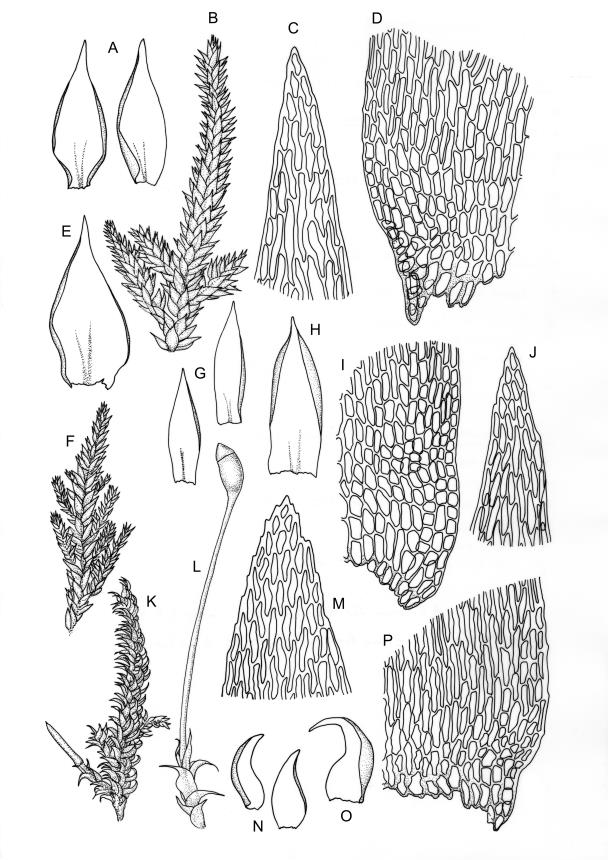
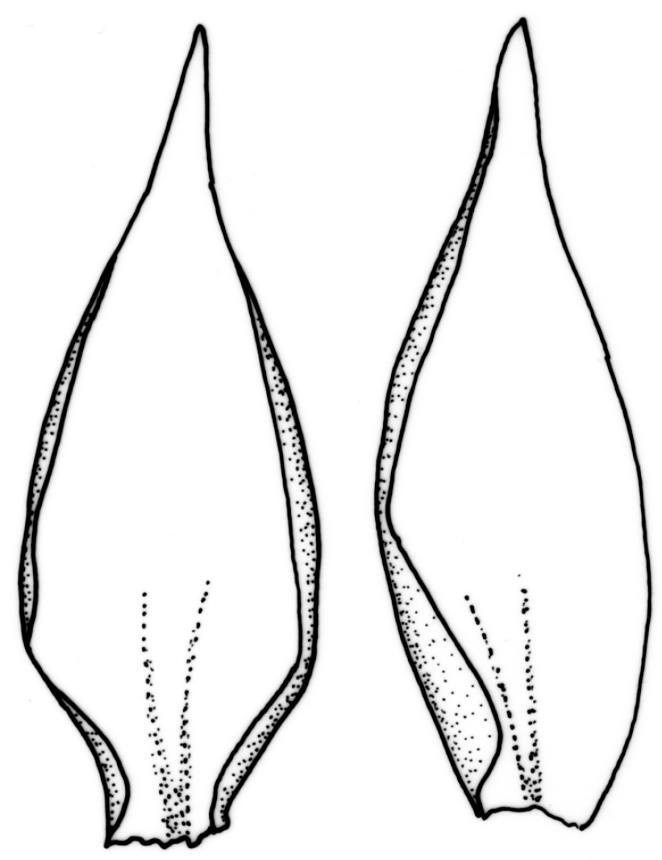
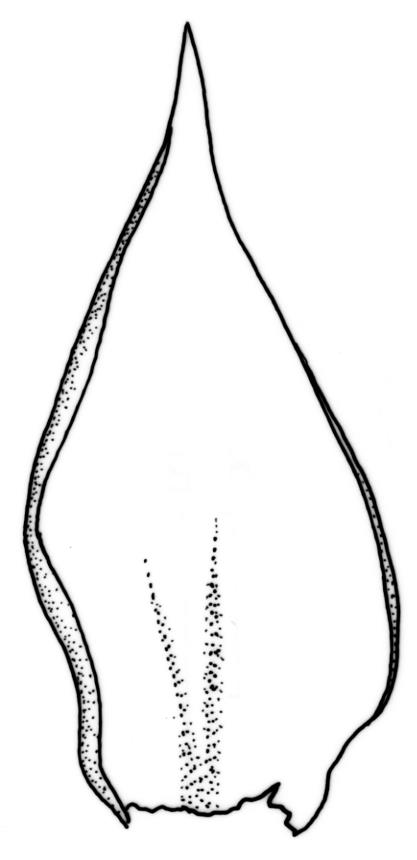
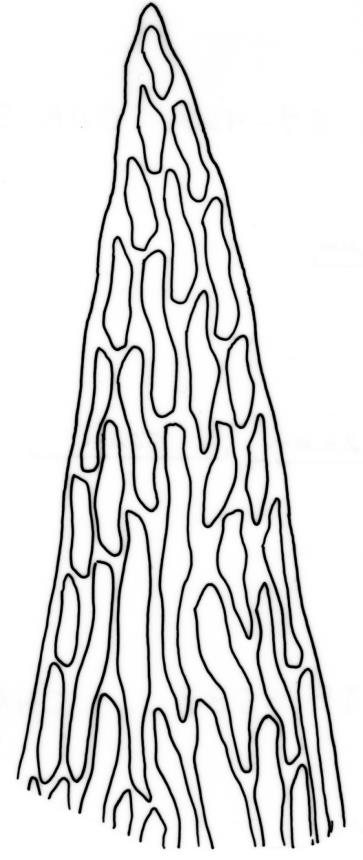
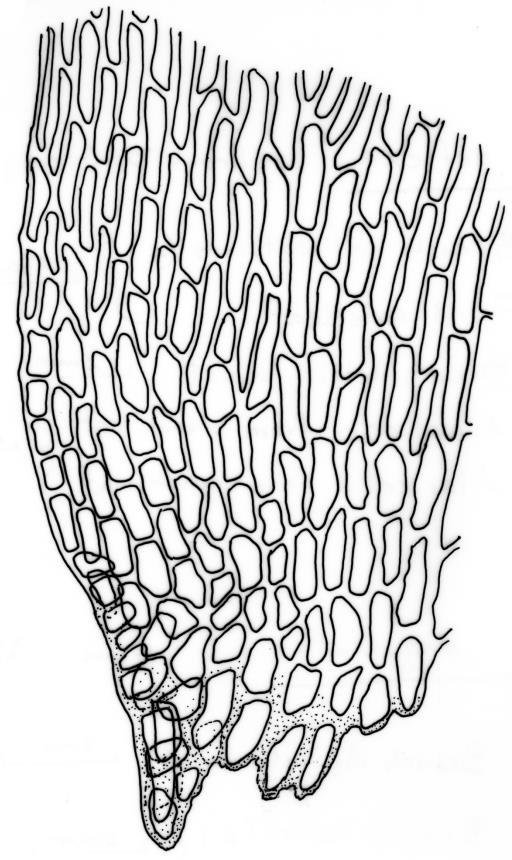
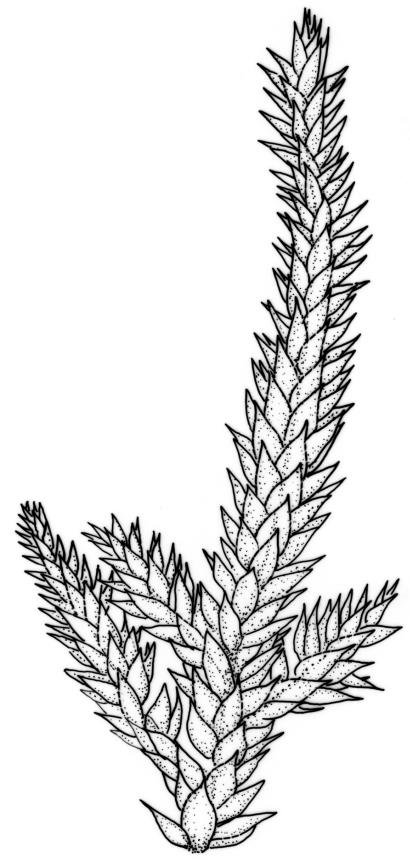
Plants usually robust, 40–80 (–100) mm long, green or green-brown, or olive green. Stems ± erect to scrambling, complanate; in cross-section oval, 560 × 380 µm with an outer layer of 3–4 cells surrounding a parenchyma and an indistinct central strand. Stipes 10–15 (–20) mm. Fronds densely and regularly 1(–2)-pinnate, variably complanate. Branches straight, distichous, moderately complanate. Frond axis leaves regularly imbricate, not or scarcely altered when dry, rarely striate, concave, ovate, acuminate-cuspidate, entire, (1.4–) 1.6–2.0 (–2.4) mm × 0.6–1.2 mm, with alar cells variable, usually forming a small group 4–6 cells wide and extending 6 cells from the leaf base, sometimes more numerous, up to 10 cells wide and extending 12 cells from leaf base. Branch leaves smaller, ovate-elliptic, with a smaller alar group, (0.9–) 1.2–1.6 × 0.5–0.9 mm. Costa double and failing below mid leaf, faint, sometimes absent. Mid laminal cells weakly porose, (32–) 40–57 (–67) × 5 µm; those above sometimes elongate, 30–40 × 5 µm, at the extreme apex c. 12–15 × 5–8 µm.
Dioicous. Setae 8–10 mm. Capsules erect or horizontal, symmetric, c. 2 × 1 mm; exothecial cells mostly 40–55 × 18–22 µm. Operculum conic, blunt or sometimes apiculate, c. 0.6 mm long. Exostome teeth c. 550–600 µm; endostome with a basal membrane ½ the exostome. Calyptra c. 2 mm. Spores (12–) 13–14 µm.
Tangney 1997, figs. 6, 7, 9, 10, 15, 20.
Camptochaete deflexa is a moderately robust plant, with densely and regularly branched compact, tidy fronds. It has regularly and neatly imbricate leaves which are ± unaltered when dry, with acuminate or cuspidate leaf apices.
Camptochaete deflexa has frequently been discussed in relation to C. arbuscula (var. arbuscula) and they may approach each other in their extreme variations. Both species produce elongate creeping forms with flattened stems and branches with a range of leaf shapes and sizes that blur the species’ boundaries. Because of this, there has been considerable confusion surrounding these two taxa, here treated as separate species.
While robust forms do occur, C. deflexa is generally a smaller plant than C. arbuscula, with often weakly developed stipes. The leaves are less concave, less wrinkled, more or less unaltered when dry, and most importantly, are usually very rigidly and regularly imbricate. This last feature, combined with leaf apices that are acute to acuminate, and densely and regularly branched compact fronds, gives this species a characteristic 'tidy' appearance which contrasts with the commonly untidy appearance of C. arbuscula. C. arbuscula is a larger plant, typically more robust than C. deflexa, with strong stipes, and large concave leaves that are collapsed-wrinkled when dry, smooth when moist, and apices that are mostly widely acute with the apex shortly pointed, if at all, rather than acuminate. Areolation is similar in both species, with C. deflexa differing in typically having longer cells in the apex. The capsules of C. deflexa are always held above the axis of the frond on elongate, slender setae, whereas those of C. arbuscula are usually borne on short, robust setae on the underside of the fronds.
Some epiphytic populations of C. deflexa with fronds smaller and finer than typical may be difficult to separate from C. angustata. When these species approach each other, they can be separated as follows: C. angustata has leaves that are narrowly elliptic-acuminate, gradually narrowed to the apex from the widest part of the leaf, which is usually at or below mid leaf. In contrast, C. deflexa has ovate-acuminate leaves, with a leaf margin that is usually somewhat concave in outline between the apex and the widest part of the leaf, with narrowing of the leaf to the apex beginning mostly above mid leaf.
Confusion may also exist between this species and C. pulvinata. C. deflexa may rarely have weakly or obscurely falcate leaves and small such forms may be difficult to separate from small, weakly falcate forms of C. pulvinata. In the latter, there are usually at least some leaves distinctly falcate at the tips, and C. pulvinata generally has broader leaf apices and more numerous alar cells.
NI: N Auckland, including offshore islands (LB, GB), S Auckland, Gisborne, Taranaki (Taranaki Maunga), Wellington; SI: Nelson, Marlborough, Canterbury, Westland, Otago, Southland; St; Ch; Sn; A; C.
Australasian. Tasmania*, mainland Australia* (Qld, N.S.W., A.C.T., Vic.).
Occurs mostly commonly in lowland forest on exposed roots and rocks close to the ground, often in or near streambeds or close to waterfalls. It also tolerates quite deep shade and can be found in shaded rock clefts and on damp soil in deeply shaded overhangs at stream margins. Altitudinal range: on North I. to 820 m at Dawson Falls (Taranaki LD), and higher on Blythe Track, Mt Ruapehu (Wellington LD) where the elevation ranges from 920 to 1380 m; on South I. from sea level (Waihōpai River, Southland LD) to 1240 m on Mt Mytton and 1460 m at Lake Peel (both Nelson LD).
Camptochaete deflexa is an earlier name for C. ramulosa. Most authors have considered it (under the latter name) to be similar to, but distinct from, C. arbuscula. Confusion has arisen from both species producing elongate forms that blur species boundaries, and that these forms were also referred to as ‘deflexa’ forms (Sainsbury 1955). The name deflexa was first used as a variety of Hypnum (Camptochaete) arbuscula (Hooker & Wilson 1844; Wilson 1854) and their concept included some of the features of C. deflexa, particularly acuminate leaves and elongate setae.
When Müller (1850–1851) published the name Hypnum deflexum Wilson, based on the variety, he stressed the elongate, complanate-filiform, deflexed branching as distinguishing the new species. These features are common to both species, and the name deflexa was treated as a variety by Dixon (1927) but included as a form of C. arbuscula by Sainsbury (1955).
Subsequent authors continued to recognise two separate species. Both Dixon and Sainsbury considered two species to be recognisable, with Sainsbury (1955) noting (of C. ramulosa) that "… this species is very near C. arbuscula, and its characters are not of great structural importance, but it is usually recognisable by the rigidly imbricated smooth leaves, with longer points, and by the longer seta. The capsule, too, is somewhat longer."
Conversely, Scott & Stone (1976) considered only one species was present: "this (Camptochaete arbuscula) is a perplexingly variable plant. The distinction between arbuscula and ramulosa given by the Handbook does not seem to hold consistently and we are provisionally treating the two species as conspecific." (p. 385). Scott and Stone considered the variability of leaf characters as too great to be of use and the seta length character as: "too feeble a specific criterion. Some other features are needed to give a convincing separation" (p. 386).
More recently, two species have been recognised (Beever et al. 1992, Fife 1995, Tangney 1997), and they can be separated based on the characters outlined above, particularly when the variation of leaf characters associated with ‘deflexa’ forms is recognised. It is generally possible to find some leaves (particularly stem or frond axis leaves) with features typical of the C. deflexa and they are a reliable guide to identification (Tangney 1997).